
Introduction: Why Speed Matters When Applying for European Work Visas
Many people dream of working in Europe. They imagine better career opportunities, higher salaries, and international experience. Yet one challenge slows down thousands of applicants every year: visa processing time.
Some European work visas take months or even years. Others are surprisingly fast when you understand how the system works.
The difference between success and frustration often comes down to choosing the right visa pathway.
Many job seekers make common mistakes:
- Applying for slow visa categories.
- Choosing countries with strict processing timelines.
- Ignoring fast-track options designed for skilled workers.
The good news is that several European countries offer fast-track work visa programs designed to attract international talent quickly.
In this detailed 2026 guide, you will learn:
- Which European work visas process the fastest.
- Real timelines and requirements.
- Industries that accelerate visa approval.
- Strategies to increase approval speed.
- Mistakes that delay applications.
Whether you are a skilled professional, entry-level worker, or experienced specialist, understanding fast visa options can dramatically reduce waiting time.
Understanding European Work Visas: How the System Really Works
European work visas allow foreign workers to live and work legally within specific countries. However, Europe does not operate one unified work visa system.
Instead, each country offers:
- National work permits.
- Skilled worker programs.
- Special talent visas.
- EU-wide programs like the EU Blue Card.
Processing speed depends on:
- Labor shortages.
- Immigration policies.
- Employer sponsorship.
- Your qualifications.
Some countries prioritize fast approvals because they need workers urgently.
According to official EU Blue Card guidelines, European nations actively streamline visa pathways to attract highly skilled professionals.
What Makes a Work Visa “Fast”?
Fast work visas typically include:
- Simplified documentation.
- Employer-driven applications.
- Priority processing for shortage occupations.
- Reduced bureaucracy.
Key factors that speed up approval:
- High-demand skills.
- Verified job offers.
- Complete documentation.
- Employer sponsorship experience.
Top Fastest European Work Visas in 2026
Let’s explore the fastest pathways currently available.
1. Germany EU Blue Card (High-Speed Skilled Worker Pathway)
Germany remains one of the fastest visa options for skilled professionals.
Why it’s fast:
- Clear salary thresholds.
- High demand for skilled workers.
- Streamlined processing for shortage roles.
Typical processing time:
- 4–8 weeks after submission.
Eligible professions:
- IT specialists.
- Engineers.
- Healthcare professionals.
Advantages:
- Pathway to permanent residency.
- Family reunification benefits.
2. Ireland Critical Skills Employment Permit
Ireland offers accelerated processing for highly skilled workers.
Fast processing reasons:
- Tech industry demand.
- Government support for international hiring.
Processing time:
- Around 6–8 weeks.
Benefits include:
- Immediate employment rights.
- Fast-track residency options.
3. Netherlands Highly Skilled Migrant Visa
The Netherlands provides one of Europe’s fastest approval systems.
Why it’s efficient:
- Recognized sponsor employers handle applications.
- Digitalized immigration systems.
Processing timeline:
- Often within 2–4 weeks.
Ideal for:
- Tech professionals.
- Engineers.
- Researchers.
4. Portugal Tech Visa
Portugal introduced tech-focused programs to attract global talent.
Fast approval advantages:
- Employer pre-certification.
- Startup-friendly policies.
Processing time:
- Approximately 4–6 weeks.
Additional benefits:
- Lower cost of living compared to Western Europe.
5. Sweden Work Permit (Priority Skilled Roles)
Sweden processes shortage occupation visas faster.
Industries prioritized:
- IT.
- Engineering.
- Healthcare.
Processing time:
- 1–3 months depending on employer.
Comparison Table: Fastest European Work Visas
| Country | Visa Type | Average Processing Time | Key Requirement |
|---|---|---|---|
| Germany | EU Blue Card | 4–8 weeks | Skilled job offer |
| Ireland | Critical Skills Permit | 6–8 weeks | High salary threshold |
| Netherlands | Highly Skilled Migrant | 2–4 weeks | Recognized employer |
| Portugal | Tech Visa | 4–6 weeks | Tech sector employment |
| Sweden | Work Permit | 1–3 months | Shortage occupation |
Industries That Accelerate Visa Approval
Certain industries receive priority due to labor shortages.
High-speed sectors include:
- Technology and software development.
- Healthcare and nursing.
- Engineering.
- Construction trades.
- Logistics and transportation.
Employers in these sectors often receive faster approvals.
Employer Sponsorship and Speed: Why Companies Matter
Employers play a huge role in processing time.
Companies with immigration experience:
- Submit accurate applications.
- Avoid delays.
- Use priority processing channels.
Choosing the right employer increases success chances significantly.
How to Increase Your Work Visa Processing Speed
Follow these strategies:
- Submit complete documentation.
- Apply through shortage occupation programs.
- Choose recognized sponsor companies.
- Avoid last-minute applications.
Preparation reduces processing delays dramatically.
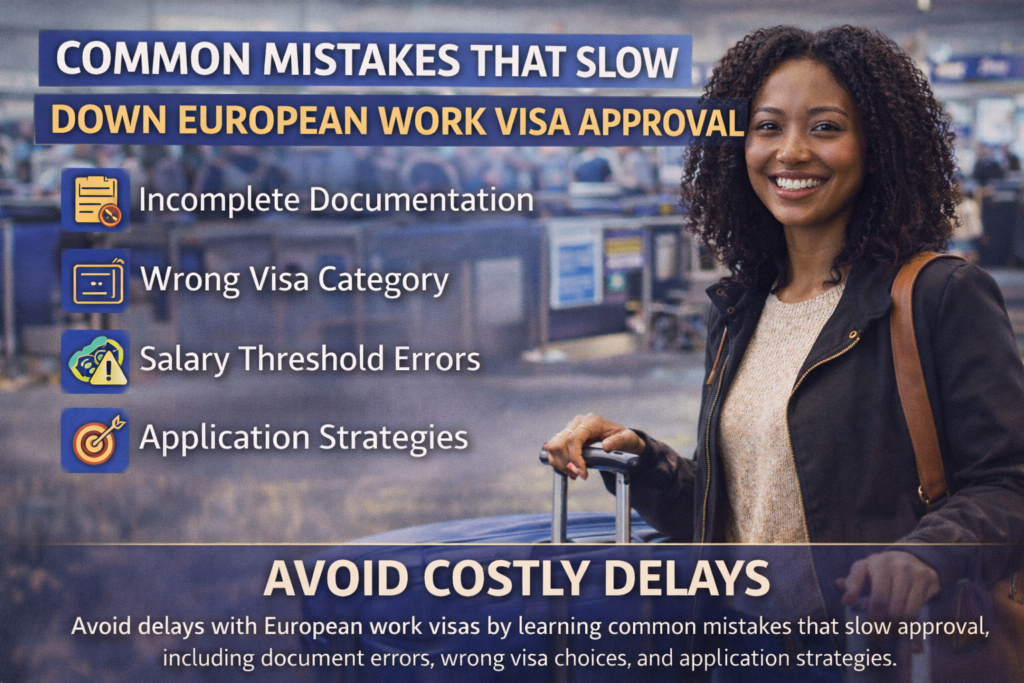 Common Mistakes That Slow Down Work Visa Approval
Many applicants assume visa delays happen because of embassy workload or immigration policies alone. In reality, a large percentage of delays come from avoidable applicant errors.
Understanding these mistakes can save weeks or even months during your visa journey.
Let’s break down the most common issues that slow down approvals — and how smart applicants avoid them.
1. Submitting Incomplete Documentation
One of the biggest causes of delays is missing paperwork.
Even small omissions can trigger:
- Additional document requests.
- File re-evaluation.
- Restarted processing timelines.
Common missing documents include:
- Signed employment contracts.
- Translated certificates.
- Proof of qualifications.
- Insurance coverage documents.
Immigration officers often pause processing until all requirements are fulfilled.
How to avoid this:
- Use official checklists from embassy websites.
- Create a personal document tracker.
- Double-check before submission.
2. Applying Under the Wrong Visa Category
Many applicants select visa types based on internet advice rather than eligibility.
Examples:
- Applying for job seeker visas instead of employer-sponsored permits.
- Choosing general work visas instead of fast-track skilled programs.
This mistake causes:
- Rejections.
- Transfers between departments.
- Processing delays.
Smart strategy:
Research which visa aligns with:
- Your salary level.
- Skill category.
- Employer sponsorship status.
3. Salary Threshold Errors
Some European work visas require minimum salaries.
Applicants often overlook:
- Gross vs net salary differences.
- Required annual income thresholds.
- Industry-specific salary requirements.
If salary details do not match official criteria, immigration officers must investigate further.
This slows approval.
4. Poorly Prepared Employer Documentation
Even when employers sponsor workers, paperwork mistakes happen.
Examples:
- Incorrect job descriptions.
- Missing company registration proof.
- Salary inconsistencies.
Experienced employers understand immigration systems better.
Applicants working with smaller companies may experience longer processing times due to learning curves.
5. Delayed Communication With Immigration Authorities
Immigration offices sometimes request additional clarification.
Common mistakes:
- Ignoring emails.
- Responding slowly.
- Providing incomplete answers.
Every delayed response extends processing timelines.
Pro tip:
Check email frequently after applying.
6. Unverified or Inconsistent Academic Certificates
Some countries verify foreign qualifications before approval.
Delays occur when:
- Certificates require evaluation.
- Degree authenticity needs confirmation.
- Professional licenses must be validated.
Applicants should confirm credential recognition early.
7. Weak Financial Preparation
Even employer-sponsored visas require personal financial stability.
Issues include:
- Insufficient bank statements.
- Missing proof of funds.
- Large unexplained deposits.
Immigration officers must investigate inconsistencies, slowing approval.
8. Missing Certified Translations
Documents in foreign languages often require certified translations.
Submitting untranslated:
- Birth certificates.
- Degree certificates.
- Police records.
creates additional processing steps.
9. Medical Insurance or Background Check Delays
Certain visas require:
- Health insurance coverage.
- Criminal background clearance.
These documents sometimes take longer than expected.
Apply for them early.
10. Applying Too Close to Travel Dates
Many applicants wait until they secure flights or housing before applying.
This creates unnecessary pressure and reduces flexibility if additional documents are requested.
Start early whenever possible.
11. Underestimating Local Registration Requirements
Some visas require post-arrival registration steps.
Delays may occur if applicants fail to:
- Book local registration appointments.
- Complete biometric requirements quickly.
Planning ahead prevents administrative bottlenecks.
12. Overloading the Application With Irrelevant Documents
More documents do not always mean stronger applications.
Too much unnecessary information can:
- Confuse reviewers.
- Increase processing time.
Focus on relevant, clear evidence.
13. Language Requirement Misunderstandings
Some roles require language proficiency proof.
Submitting incorrect or outdated certificates may trigger additional checks.
Always verify accepted language tests.
14. Ignoring Country-Specific Rules
Each European country has unique processes.
Applicants often assume rules are identical across Europe.
They are not.
Example differences:
- Germany emphasizes qualification recognition.
- Netherlands prioritizes recognized employers.
- Ireland focuses on salary thresholds.
15. Applying Without Understanding Processing Timelines
Some applicants submit applications without knowing realistic timelines.
They may:
- Panic unnecessarily.
- Submit duplicate inquiries.
- Make unnecessary changes.
Understanding expected timelines reduces stress.
The majority of delays do not come from strict immigration systems. They come from small preparation mistakes.
The fastest approvals happen when:
- Documentation is complete.
- Eligibility matches visa category.
- Employer and applicant coordinate clearly.
Preparation is your strongest advantage.
Fast Visa vs Easy Visa: Understanding the Difference
This does not always mean easy.
Fast visas require:
- Strong qualifications.
- Verified job offers.
Easy visas may exist but often take longer.
Salary Thresholds and Processing Speed
Higher salaries often receive priority.
Reasons:
- Skilled migration policies favor high-value roles.
- Employers demonstrate stronger economic contribution.
Budget and Relocation Planning
Even fast visas require financial preparation.
Plan for:
- Travel expenses.
- Temporary housing.
- Insurance requirements.
Psychological Reality: Why Many Applicants Feel Delayed
Applicants often feel frustrated because:
- Expectations are unrealistic.
- Documentation takes longer than expected.
Understanding timelines helps reduce stress.
Future Trends for Fast European Work Visas (2026 and Beyond)
Expected developments:
- Digitalized immigration systems.
- Increased shortage occupation programs.
- Faster processing for tech and healthcare roles.
Europe continues competing globally for talent.
Conclusion: Choosing the Right Fast Work Visa Can Transform Your Career Journey
Working in Europe does not have to involve long waiting periods. By understanding which visa pathways prioritize speed, you position yourself strategically.
Focus on:
- High-demand sectors.
- Countries offering streamlined processing.
- Employers experienced with sponsorship.
Smart planning turns complex immigration systems into achievable opportunities.
The fastest path is not just about speed. It is about choosing the right strategy from the beginning.
FAQs
1. Which European country offers the fastest work visa?
The Netherlands highly skilled migrant visa is among the fastest when sponsored by recognized employers.
2. Can I apply for fast-track visas without a job offer?
Most fast work visas require a confirmed job offer.
3. Are fast work visas only for tech professionals?
No. Healthcare, engineering, and logistics roles also qualify.
4. Does higher salary speed up approval?
Often yes, especially for skilled migration programs.
5. Can family members join on fast work visas?
Many programs allow family reunification.